Are the costs of genome sequencing underestimated?

Four years ago I blogged on how “The $1000 genome is a myth”. I think the first paragraph from that blog post is as relevant today as it was in 2015:

Barely a day goes by without a news story or social media post proclaiming that the $1000 genome now exists, and is ushering in a healthcare revolution. Every day, somebody, somewhere in the world, posts these graphs on Twitter. There’s even a Wikipedia page devoted to this topic. It’s a persistent news headline and, frustratingly, it’s currently wrong.

Since 2015, the health economic evidence base for genome sequencing has gradually expanded, and several cost estimates are now available, but overall I think we still lack the sort of rigorously conducted microcosting studies that can usefully inform resource allocation decisions regarding genomic testing.

Hopefully this paper that we published in Genetics in Medicine a couple of weeks’ ago can make such a contribution.

Continue reading

Blog posts welcome!

When I started this blog in 2014 I wanted to provide a forum for the discussion of issues surrounding the health economic analysis of genomic technologies. I knew that I would start off by writing most of the blog posts, but my plan in the medium-term was to invite researchers from all backgrounds to contribute posts. However, this was not something I ever really got around to publicising. Consequently there has only been one guest post since this blog began.

I have less time to write for the blog now, so this seems like a good opportunity to put the call out for more guest posts. If you would like to contribute a post on any topic related to health economics and genomics, please get in touch. You can do this via the contact form, or via a DM on Twitter, or via my email address. There are no restrictions on the topic of posts: these could be paper reviews, comments on current issues in the field, editorial type posts, methods discussions or even debate-type posts. If you have something to say on health economics and genomics that requires more space than the 280 characters offered by Twitter, but isn’t quite right for a formal peer-reviewed paper, then this could be the format for you. I do not intend/want to edit any posts other than to do some light touch editing to fix typos etc.: there is no blog ‘voice’, and all opinions are welcome.

If you are interested in contributing, please get in touch!

Do health professionals value genomic testing?

Apologies for the lack of activity on this blog. The amount of time I have for writing blog posts has reduced considerably over the past few months! I do hope to begin writing more general blog posts again soon, but I’m checking in today to highlight a paper that we published this week in the European Journal of Human Genetics.

Continue reading

HERC database of health economics and genomics studies launched today

An increasing number of qualitative and quantitative research papers in health economics and genomics have been published in recent years. To keep track of these publications, and to have a useful summary of available publications at hand, researchers at HERC have set up a database of health economics and genomics studies. I have helped to set up this database, as has Sarah Wordsworth, but a first-year PhD student, Patrick Fahr, has undertaken most of the hard work and should receive the lion’s share of the credit!

Database screenshot 09May18

Continue reading

Are whole-exome and whole-genome sequencing approaches cost-effective?

Yesterday, we published an article in Genomics in Medicine titled: “Are whole-exome and whole-genome sequencing approaches cost-effective? A systematic review of the literature”. The lead author for this work was Katharina Schwarze, who spent several months at HERC working on a project related to the costs of whole genome sequencing.

The aim of this particular piece of work was to summarise the current health economic evidence for whole-exome sequencing (WES) and whole-genome sequencing (WGS). The key finding was that the current health economic evidence base to support the more widespread use of WES and WGS in clinical practice is very limited. Other important findings include the following:

  • Cost estimates for a single test ranged from $555 to $5,169 for WES and from $1,906 to $24,810 for WGS.
  • There was no evidence that the cost of WES was falling over time, and only limited evidence that the cost of WGS was decreasing.
  • Few studies used outcome measures recommended for use in economic evaluations, such as survival or quality of life.
  • Only eight publications were full economic evaluations, of which only five produced evidence that WES or WGS may represent a cost-effective use of limited health-care resources.

We conclude by making four practical recommendations:

  1. Future studies should report costs by stage of testing for WES and WGS and highlight particularly notable costs, as it is currently difficult to identify key cost drivers.
  2. Future studies should report resource use and unit costs in a disaggregated manner to aid interpretation.
  3. Future studies evaluating the cost-effectiveness of WES or WGS should use calculated costs instead of prices, to better capture the economic value associated with WES and WGS, and to avoid incorrect and inefficient adoption decisions.
  4. Future studies of the cost-effectiveness of WES and WGS should include trained health economists as coinvestigators to improve study quality.

This paper challenges a number of assumptions in the literature and in the wider conversation regarding the cost and potential value of next generation sequencing technologies. I hope you’ll read, share, and debate these findings!

Medicine’s future? The health economics of population-wide genomic screening

The latest issue of Science contains an interesting and lengthy article on how Geisinger are trying to integrate genomic screening into routine care in Pennsylvania, USA. Although this is an exciting area of research, and the business model surrounding these innovative approaches to genomic sequencing is quite interesting, I have a number of reservations about the cost-effectiveness of population-wide genomic screening.

Continue reading

Using genomic information to guide ibrutinib treatment decisions in chronic lymphocytic leukaemia

A quick update for you on my PhD publications. Last year, I completed my PhD which considered the issues surrounding the economic analysis of genomic diagnostic technologies in the UK NHS. So far, I have published three papers reporting the results of this work:

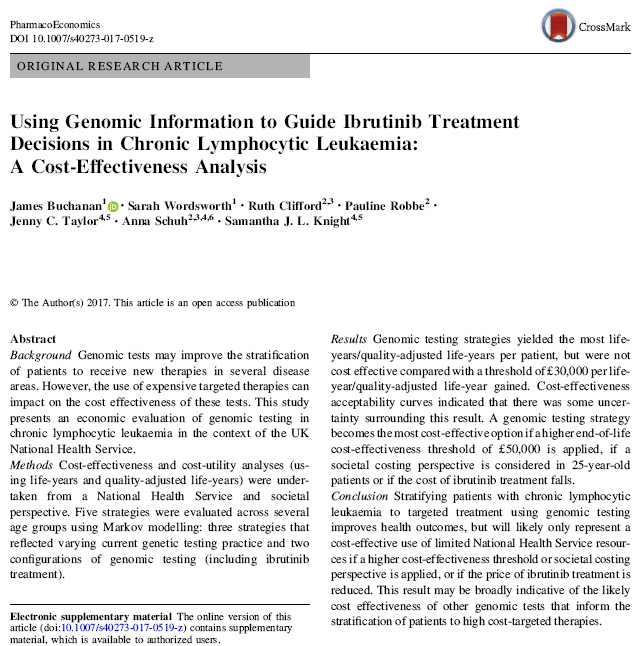
I am pleased to be able to report that the fourth paper arising from my PhD work was published today in PharmacoEconomics, titled: “Using genomic information to guide ibrutinib treatment decisions in chronic lymphocytic leukaemia: A cost-effectiveness analysis“.

Capture

Continue reading

Whole genome sequencing costs – a step in the right direction

It is now well documented that health economic evidence to inform commissioning decisions regarding genomic tests is in short supply. This lack of evidence relates to both costs and health outcomes – there is perhaps an understandable tendency to focus on the issues surrounding the measurement of health outcomes in genomics, but data on costs is equally sparse and the generation of such data is also beset by practical and methodological challenges. That said, in the past twelve months we have started to finally see some good quality data emerging on the costs of whole genome and whole exome sequencing, and a recent paper by Kate Tsiplova and colleagues has made a notable contribution to this literature.

Continue reading

New PhD opportunity in health economics and genomics

I’m pleased to announce that we are offering a DPhil (PhD) position here at the Health Economics Research Centre in the area of health economics and genomics. The proposed start date is October 2017 and the full title is “Linking genomic and clinical data in health economic evaluations: identifying challenges and exploring potential solutions“.

The aim of this DPhil project is to comprehensively investigate the challenges and opportunities in this area using data from the 100,000 Genomes Project, with an emphasis on rare diseases.

The deadline for applications is 1200 noon UK time on Friday 6th January 2017.

If anybody has any questions about this project then please don’t hesitate to get in touch by email (james.buchanan@dph.ox.ac.uk). Please also share the details of this project with anybody who you think might be interested.

Full details of this project are available here.

blog-logo

What are people willing to pay for whole genome sequencing information?

Given the wide variety of health and non-health outcomes associated with genomic tests, it is perhaps particularly important that the preferences of key stakeholders are considered within the health technology assessment process for these interventions. Indeed, in a paper published last year, Rogowski et al. highlight the importance of ‘preference-based personalization’ in this context. To date, few studies have generated data on preferences for genomic tests. However, a recent publication in Genetics in Medicine by Deborah Marshall and colleagues has attempted to address this gap in the literature.

Continue reading