The latest issue of Science contains an interesting and lengthy article on how Geisinger are trying to integrate genomic screening into routine care in Pennsylvania, USA. Although this is an exciting area of research, and the business model surrounding these innovative approaches to genomic sequencing is quite interesting, I have a number of reservations about the cost-effectiveness of population-wide genomic screening.
Year: 2017
Using genomic information to guide ibrutinib treatment decisions in chronic lymphocytic leukaemia
A quick update for you on my PhD publications. Last year, I completed my PhD which considered the issues surrounding the economic analysis of genomic diagnostic technologies in the UK NHS. So far, I have published three papers reporting the results of this work:
- Paper 1 (2013): “Issues surrounding the health economic evaluation of genomic technologies”
- Paper 2 (2015): “Welfarism versus extra-welfarism: can the choice of economic evaluation approach impact on the adoption decisions recommended by economic evaluation studies?”
- Paper 3 (2016): “Patients’ Preferences for Genomic Diagnostic Testing in Chronic Lymphocytic Leukaemia: A Discrete Choice Experiment”
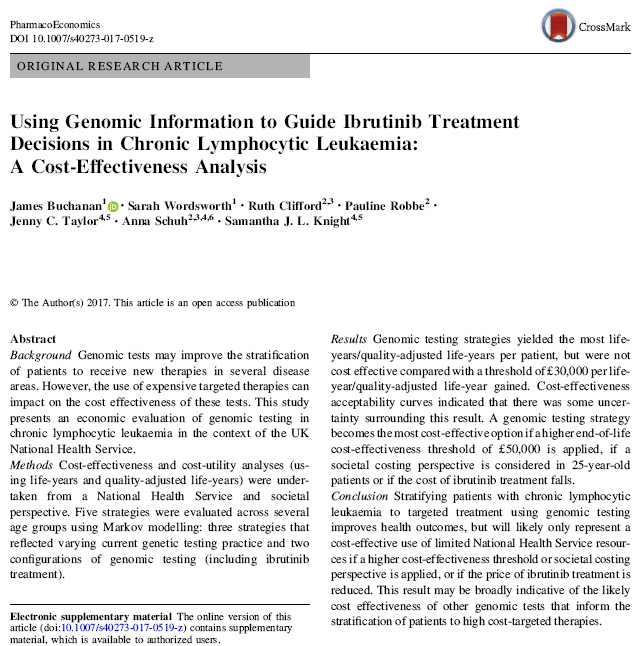
I am pleased to be able to report that the fourth paper arising from my PhD work was published today in PharmacoEconomics, titled: “Using genomic information to guide ibrutinib treatment decisions in chronic lymphocytic leukaemia: A cost-effectiveness analysis“.
Whole genome sequencing costs – a step in the right direction
It is now well documented that health economic evidence to inform commissioning decisions regarding genomic tests is in short supply. This lack of evidence relates to both costs and health outcomes – there is perhaps an understandable tendency to focus on the issues surrounding the measurement of health outcomes in genomics, but data on costs is equally sparse and the generation of such data is also beset by practical and methodological challenges. That said, in the past twelve months we have started to finally see some good quality data emerging on the costs of whole genome and whole exome sequencing, and a recent paper by Kate Tsiplova and colleagues has made a notable contribution to this literature.
Health economics, genomics and the value of knowing
In July 2016, the Office for Health Economics and the European Personalised Medicine Association published a white paper titled: “The Value of Knowing and Knowing the Value: Improving the Health Technology Assessment of Complementary Diagnostics”. This publication did not receive a great deal of attention at the time, but it raises some interesting points related to genomic testing that are worthy of consideration by a wider audience. In particular, it highlights several things that we currently do reasonably well in health economics and genomics, as well as some areas in which we need to improve evidence generation, suggesting a future research agenda in this field.
 Health Economics and Genomics