Are whole-exome and whole-genome sequencing approaches cost-effective?

Yesterday, we published an article in Genomics in Medicine titled: “Are whole-exome and whole-genome sequencing approaches cost-effective? A systematic review of the literature”. The lead author for this work was Katharina Schwarze, who spent several months at HERC working on a project related to the costs of whole genome sequencing.

The aim of this particular piece of work was to summarise the current health economic evidence for whole-exome sequencing (WES) and whole-genome sequencing (WGS). The key finding was that the current health economic evidence base to support the more widespread use of WES and WGS in clinical practice is very limited. Other important findings include the following:

  • Cost estimates for a single test ranged from $555 to $5,169 for WES and from $1,906 to $24,810 for WGS.
  • There was no evidence that the cost of WES was falling over time, and only limited evidence that the cost of WGS was decreasing.
  • Few studies used outcome measures recommended for use in economic evaluations, such as survival or quality of life.
  • Only eight publications were full economic evaluations, of which only five produced evidence that WES or WGS may represent a cost-effective use of limited health-care resources.

We conclude by making four practical recommendations:

  1. Future studies should report costs by stage of testing for WES and WGS and highlight particularly notable costs, as it is currently difficult to identify key cost drivers.
  2. Future studies should report resource use and unit costs in a disaggregated manner to aid interpretation.
  3. Future studies evaluating the cost-effectiveness of WES or WGS should use calculated costs instead of prices, to better capture the economic value associated with WES and WGS, and to avoid incorrect and inefficient adoption decisions.
  4. Future studies of the cost-effectiveness of WES and WGS should include trained health economists as coinvestigators to improve study quality.

This paper challenges a number of assumptions in the literature and in the wider conversation regarding the cost and potential value of next generation sequencing technologies. I hope you’ll read, share, and debate these findings!
Medicine’s future? The health economics of population-wide genomic screening

The latest issue of Science contains an interesting and lengthy article on how Geisinger are trying to integrate genomic screening into routine care in Pennsylvania, USA. Although this is an exciting area of research, and the business model surrounding these innovative approaches to genomic sequencing is quite interesting, I have a number of reservations about the cost-effectiveness of population-wide genomic screening.

Continue reading

Using genomic information to guide ibrutinib treatment decisions in chronic lymphocytic leukaemia

A quick update for you on my PhD publications. Last year, I completed my PhD which considered the issues surrounding the economic analysis of genomic diagnostic technologies in the UK NHS. So far, I have published three papers reporting the results of this work:

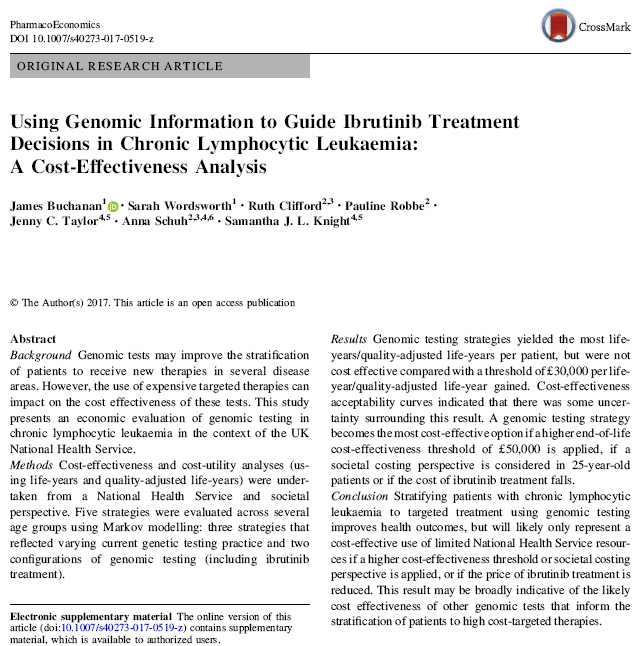
I am pleased to be able to report that the fourth paper arising from my PhD work was published today in PharmacoEconomics, titled: “Using genomic information to guide ibrutinib treatment decisions in chronic lymphocytic leukaemia: A cost-effectiveness analysis“.

Capture

Continue reading

Whole genome sequencing costs – a step in the right direction

It is now well documented that health economic evidence to inform commissioning decisions regarding genomic tests is in short supply. This lack of evidence relates to both costs and health outcomes – there is perhaps an understandable tendency to focus on the issues surrounding the measurement of health outcomes in genomics, but data on costs is equally sparse and the generation of such data is also beset by practical and methodological challenges. That said, in the past twelve months we have started to finally see some good quality data emerging on the costs of whole genome and whole exome sequencing, and a recent paper by Kate Tsiplova and colleagues has made a notable contribution to this literature.

Continue reading

New PhD opportunity in health economics and genomics

I’m pleased to announce that we are offering a DPhil (PhD) position here at the Health Economics Research Centre in the area of health economics and genomics. The proposed start date is October 2017 and the full title is “Linking genomic and clinical data in health economic evaluations: identifying challenges and exploring potential solutions“.

The aim of this DPhil project is to comprehensively investigate the challenges and opportunities in this area using data from the 100,000 Genomes Project, with an emphasis on rare diseases.

The deadline for applications is 1200 noon UK time on Friday 6th January 2017.

If anybody has any questions about this project then please don’t hesitate to get in touch by email (james.buchanan@dph.ox.ac.uk). Please also share the details of this project with anybody who you think might be interested.

Full details of this project are available here.

blog-logo

Genomics at the 2015 iHEA meeting in Milan

Apologies for the recent lack of blog posts. It turns out it takes a lot of effort to get a PhD written up alongside other research commitments. Normal service will be resumed very soon. For now, a few quick notes on the International Health Economics Association meeting in Milan which has just concluded. Specifically, this is a quick review of the presentations that I attended which had a link (however tenuous!) to genomics. Continue reading

Cost-effectiveness analysis and genetics – the zombie technique that will never die

Terry Flynn recently blogged on how treatment tailored to genes will kill economic evaluation. It’s a catchy title that I hope will draw health economists working outside of genetics into a growing debate on the best way to do economic evaluation in genetics and genomics. However, I don’t entirely agree with everything that Terry said and wanted to respond on a few points:

Continue reading

Welfarism versus extra-welfarism: an important analytical decision in genomics?

In my first blog post, I posed a number of questions that were relevant in health economics and genomics. One of these was “Is there a greater role for cost-benefit analysis in genomics?”. I’m working towards contributing to this debate with my PhD (if I ever finish), and one of the byproducts of my PhD is this paper, published over the weekend in PharmacoEconomics, titled: “Welfarism Versus Extra-Welfarism: Can the Choice of Economic Evaluation Approach Impact on the Adoption Decisions Recommended by Economic Evaluation Studies?”. I hope it mght be relevant to other health economists working in genomics, so I thought I would share it here. There are (hopefully!) a few findings of note, but I guess the main take-home message is this: “We found that for every five studies applying both approaches, one shows limited or no concordance in economic evaluation results: the different approaches suggest conflicting adoption decisions, and there is no pattern to which approach provides the most convincing adoption evidence”. It certainly provides food for thought when designing economic evaluations in genomics.

Incidental findings in genomic sequencing: a health economics perspective

When this blog began, I mentioned that I would be happy to publish posts by other researchers: different opinions and healthy debate are both welcome here. I’m therefore very pleased to introduce a colleague of mine at the University of Oxford, Jilles Fermont, who discusses some recently published articles on incidental findings in genomic sequencing from a health economics perspective.

Incidental findings (IFs) are a topic of considerable debate, not just in genomic medicine but also in other fields of medicine. To date, few health economists have undertaken any work in this area, but a recent burst of publications suggests that this is beginning to change. This post is primarily prompted by the publication of a paper in Genetics in Medicine earlier in November titled “The cost-effectiveness of returning incidental findings from next-generation genomic sequencing”, authored by Bennette and colleagues. The authors intended to evaluate the clinical and economic impact of IFs in genomic sequencing. The cost-effectiveness analysis (CEA) is restricted and has limitations (see below) but, as the authors already indicated, it is much more of an exploratory study providing policy recommendations on how to deal with IFs from genomic sequencing. Also, it is not a CEA of next-generation sequencing (NGS) but that of the return of IFs. Despite these caveats, it remains an interesting and relevant paper. Those involved or interested in this field are recommended to read it.

Continue reading

Introduction

Hello. Chances are you’re a health economist, although you might also be a researcher in a different field of healthcare. You might even be a scientist (apologies in advance for any bad science that might follow). Whoever you are, you’re very welcome. The aim of this introductory post is to tell you what you should expect from this blog. Hopefully you’ll be sufficiently intrigued to return, read some more articles and contribute to the growing debate surrounding the application of standard health economic methods in the field of genomics.

This blog is going to assume that you know a little bit about genomics. Specifically, this blog is going to assume that you have at least read the “What are genomic technologies?” section of this blog, a short introduction for a layperson who already has a little bit of science knowledge. Of course, many of you will have a greater knowledge of genetics and genomics than this simple introduction, but this blog is intended to be broadly accessible to stimulate wide debate, so the aim is to keep the genomics jargon to a minimum. This blog is also going to assume that the average reader has some basic knowledge about health economics. Those who don’t could do a lot worse than frequent the excellent “Academic Health Economists’ Blog”.

Continue reading